On 07 November 2025, the Payments Vision Delivery Committee (PVDC) published its “Strategy for Future Retail Payments Infrastructure.”
As a quick refresher, the PVDC was set up in November 2024 to realise the National Payments Vision (NPV) – which set out the ambition for a world-leading payments ecosystem – and comprises representatives from HM Treasury (HMT), the Bank of England, and the Financial Conduct Authority (FCA) and Payment Systems Regulator (PSR). It was supported by the ‘Vision Engagement Group’ comprising 30 senior payments industry representatives.
An update from the PVDC in July outlined the public-private approach to realising the NPV and announced the establishment of the Retail Payments Infrastructure Board (RPIB) and creation of a new ‘Delivery Company’. The latest update is short, sharp and substantive, setting out “five high-level strategic outcomes” for the role of the new retail payments infrastructure. This will guide the work of the RPIB, which held its first meeting in October.
In summary, the gauntlet has been thrown down for the RPIB in 2026 to develop the full strategy for the UK’s retail payments infrastructure, establishing clear priorities and timelines, and requiring some hard choices and trade-offs.
We wait with great anticipation to hear from the RPIB about the process it intends to follow over the next year, including potential consultations and target publication dates. Yet in the meantime, I highlight three key points of interest within the update:
1. The future is getting closer. Really.
Firstly, let’s explore the five ‘high-level strategic outcomes’ themselves.
Four are very familiar to all fans of payment strategy and policy initiatives over the last decade or more: choice and cost-effectiveness for end users; increased trust through protection against fraud and financial crime; ensuring payments providers have fair access to the central infrastructures; and, of course, resilience, resilience, resilience. Market outcomes on these points over the last decade may have been varied, but these ambitions have been clear and consistent, and it's good to see them reaffirmed.
While these are the greatest hits of payments policy, we do have one new entry coming in at number two: “Payments operate seamlessly as part of a diverse multi-money ecosystem, with interoperability between new and existing forms of digital money”.
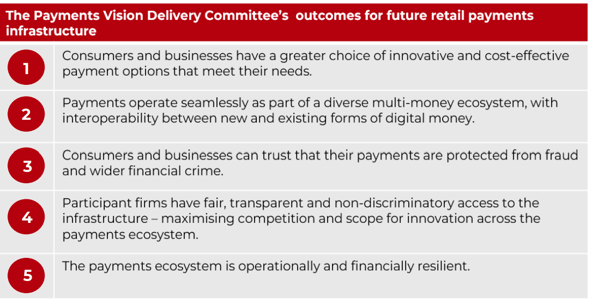
© Crown copyright 2025
It is significant that operating seamlessly as part of a “diverse multi-money ecosystem” is called out explicitly by HMT as a top-level outcome. It means that electronic / digital payments running over established rails – such as BACS, Faster Payment System (FPS), card networks and LINK – should operate seamlessly with new forms of money. These could potentially include stablecoins, tokenised deposits, or a retail CBDC ‘digital pound’.
This reflects recent industry discussions and initiatives. For instance, the Bank of England is doing much good work in assessing options for a digital pound. UK Finance has also been leading an assessment of ‘regulated liability networks’, moving recently towards a pilot for ‘GB Tokenised Deposits’. The RPIB will need to encompass these emerging areas of work, as well as other developing programmes.
2. A better Faster Payments System is coming
The report endorses the current programme of work, led by Pay.UK, to deliver some key enhancements to the FPS in the short-term. A procurement exercise is publicly under way for a new Access Layer (e.g. a RFI was issued in August), and other potential enhancements could include enhancing ‘certainty of fate’ for account-to-account payments over FPS to be viable for consumer purchases online or in store. These enhancements are also likely to include adopting ISO 20022 in some form, given the industry view that becoming ISO 20022-native should be the de-facto standard for payment processing within organisations. Following the path of SEPA, CHAPS and CBPR+, any payments that are not ISO 20022-compliant will need to change.
The industry is in discussion with Pay.UK on these, with further updates on content, timelines and sequencing highly anticipated.
3. Thinking beyond FPS and BACS
After the nearer-term FPS enhancements referenced above, the PVDC update also clearly outlines that the RPIB’s strategy absolutely needs to consider options beyond the existing FPS and BACS systems.
This is outlined in paragraph 1.9, which states that: “it is essential that the RPIB’s work […] considers the optimal future ‘set-up’ for the UK’s retail payments infrastructure, recognising that the ‘frontier’ of technological developments continues to shift. This means it needs to think beyond a like-for-like upgrade of the existing Faster Payment System and Bacs Payment System, while ensuring continuity of the services that users currently expect and rely on.”
This marks another important development. The previous NPA initiative was certainly looking to replace FPS, though arguably was seen as pursuing a like-for-like approach. It’s great to see HMT seeking to provoke this debate for FPS, while also opening the door to a robust discussion about future options to service the bulk credits and bulk debits (and other services) currently provided by BACS.
As part of this, the future debate will need to consider options based on ‘traditional’ payments rails technologies, versus the viability and timing for a large-scale infrastructure running over newer solutions like distributed ledger technology (DLT). Many approaches could be taken; one, potentially, is a twin-track approach where a ‘traditional’ infrastructure is adapted for a 7-10-year timeframe, while in parallel the industry develops and scales up a blockchain-based rail to supersede it as the dominant platform further out.
Adjusting to a Brave New Payment Vision
Taking together the two PVDC updates in July and November, the agenda has been set for significant work in 2026 led by the RPIB, with (we hope) interim reports being produced two or three times during the year.
Make no mistake, these are undoubtedly critical discussions for providers and operators of payment systems, given the huge volumes of transactions that flow every day and the scale and timing of investments required. While acknowledging that uncertainty remains around timelines and final design, the direction of travel is unmistakable. Banks should already be evaluating their readiness, rationalising legacy flows, and planning for ISO-native Faster Payments processing. Payments providers will need to consider upgrading existing, or implementing new, core payments engines and gateways to interact with the central payment infrastructures that are developed.
Icon can work with you to understand your options and optimise your decisions. Our extensive work with our clients to develop payments strategy, architecture designs and drive implementation can help to navigate the transition ahead and realise its full potential.


.jpg?width=668&height=376&name=iStock-2239372573%20(small).jpg)